Light Entrains the Circadian Rhythm
In humans, exposure of the retina to daylight has a powerful effect on the circadian rhythm, the internal clock that helps regulate the timing of wakefulness and sleep, along with many other physiological processes. The timing, duration and intensity of daylight exposure have a direct influence on daily sleep/wake cycles due to the ability of specialized retinal cells to relay this information to the brain’s master clock. Modern routines, such as spending most of the day indoors or working night shifts, have reduced daytime light exposure and increased exposure to artificial light at night for many people. Changes in exposure to daylight, whether due to modern lifestyles or seasonal variation in daylight, are thought to contribute to a delayed sleep phase, low daytime energy, and even the mood changes associated with seasonal and non-seasonal depression.
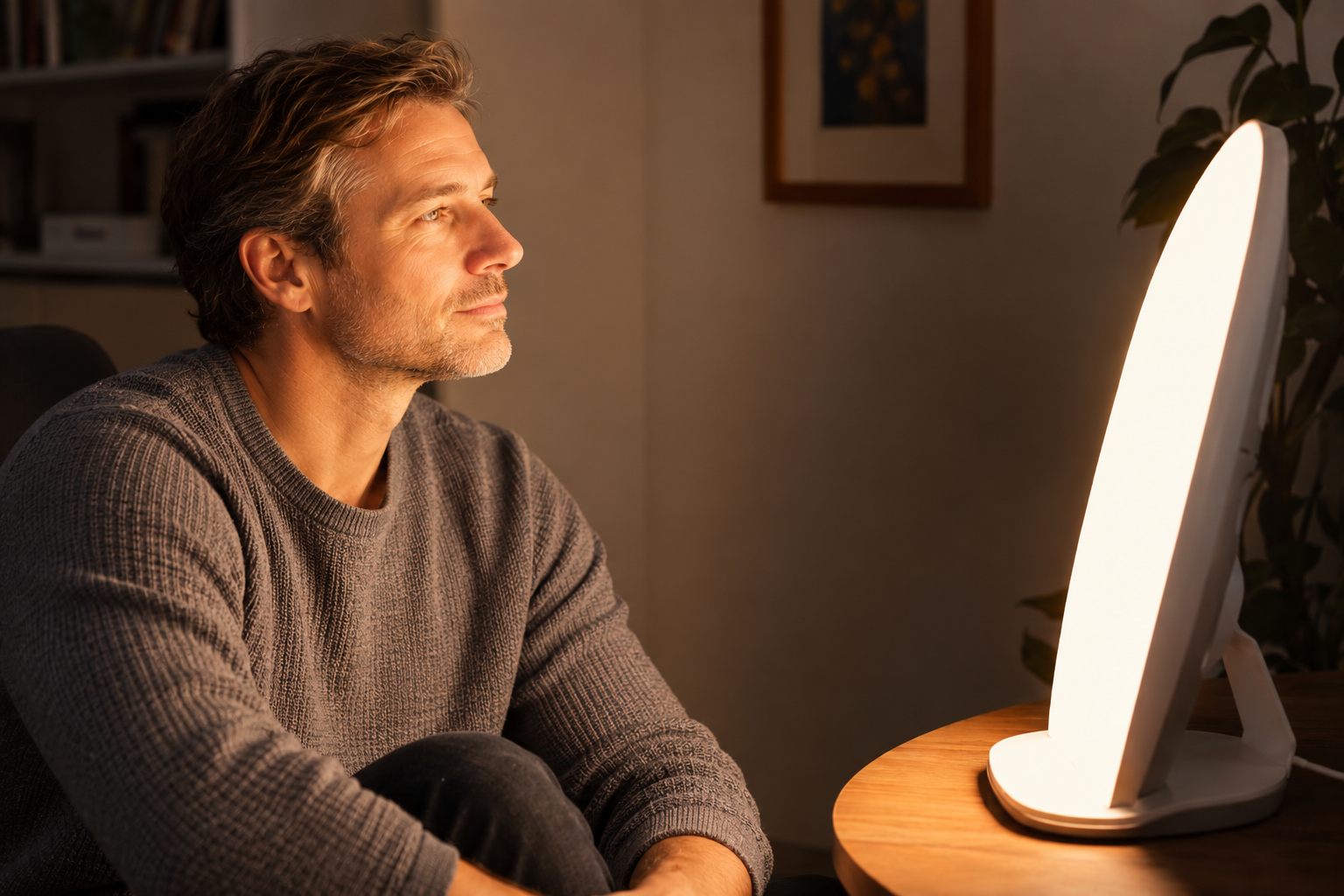
Bright light therapy is an intervention that uses very bright, artificial light exposure, specifically to the eyes, for the treatment of seasonal and non-seasonal depression, as well as some circadian rhythm abnormalities. Bright light therapy is distinct from other forms of light therapy used for photobiomodulation, such as infrared (IR) or red light therapy, and has a very different use and more extensive, higher quality evidence-base. Bright light therapy devices are also distinct from the UV phototherapy devices used in dermatology for skin conditions, and actually filter out UV light for safety reasons.
In order for bright light therapy to be effective, the device must be used in the correct way. The time of day, duration of light-treatment, device settings, and even the distance of the light to your eyes must all be chosen correctly in order to benefit from this treatment. While clinical supervision is highly recommended for individuals using bright light therapy for depression or sleep disorders, this article is meant to provide general guidance on how to effectively use bright light therapy devices.
Instructions For Use of Bright Light Therapy:
What Device Should You Use?
You should use a device that is able to produce a brightness of 10,000 lux. This is the brightness of light used in clinical research studies for treatment of seasonal and non-seasonal depression. Only use devices that include guidance on the distance your eyes should be from the light source.
When Should You Use Bright Light Therapy?
Use bright light therapy at the same time every morning, as soon as possible after your current waking time, including on weekends. Research suggests earlier morning light is generally more effective than later light.
How Bright Should the Light Be?
Use the setting for 10,000 lux on your device, if available.
Where Should You Rest Your Gaze?
Your eyes should be open, with the light in your field of view, but don’t stare directly into it. This isn’t necessary for the treatment to work and can be uncomfortable. If you have an eye condition or take medications that increase light sensitivity, check with your doctor before starting.
How Far Away Should The Light Be?
The answer to this question depends on the specific bright light therapy device that you are using. Read the instructions on the device; these instructions should provide guidance on how far away your eyes should be from the light source.
How Long Should You Use Bright Light Therapy?
Most clinical research studies use a duration of 30 minutes each morning. For seasonal depression it is recommended to continue daily use until spring. For non-seasonal depression it is best to continue daily treatment for at least 4 weeks, and speak with your clinician before you discontinue treatment.
For those using bright light therapy for circadian rhythm disturbances the duration of treatment is less clear. Once your sleep cycle has returned to normal, most people need to keep a consistent wake time and morning light to maintain their new schedule.
Helpful Tips
If you are not able to tolerate the intensity of the light, try moving the device a bit further away, or try a lower light setting, for several days, until you can tolerate the correct distance and intensity.
If you find that you are sleeping less, have an abnormally elevated mood, become irritable, or are engaging in high-risk activities, and/or develop new or worsening suicidal thoughts after starting early morning bright light therapy, stop using the device and see your physician, or seek emergency services, immediately.
If you find that you are waking up too early, or experiencing early evening fatigue after starting early morning bright light therapy, the light may be shifting your body clock too far. Try shortening your sessions or starting them a little later, and talk with your clinician.
People with known bipolar disorder should use light therapy only under a clinician’s supervision, often alongside a mood stabilizer, and possibly at midday rather than in the morning.
Megan Bowers, MD, PhD is a child, adolescent, and adult psychiatrist specializing in neurodevelopmental disorders, and is the founder of Bowers Integrative Psychiatry and CEO and Medical Director of The Mind Grove TMS Center. Her work focuses on integrative approaches to mental health, combining evidence-based medication management with lifestyle and mind–body interventions.
The information provided on this website is for educational purposes only and is not intended as medical advice. It should not be used to diagnose or treat any condition. Please consult a qualified healthcare professional for individualized medical guidance. Use of this website does not establish a physician–patient relationship.
Book a Free Introductory Call
If you or a family member are considering bright light therapy and would like guidance from a clinician, a free 15-minute introductory call is a good place to start. This conversation allows you to share what you are observing and learn how an integrative approach can help.
Bowers Integrative Psychiatry provides in-person appointments in Colorado Springs and telehealth throughout Colorado, Maryland, Montana, New York, Oregon, and Washington. View rates and fees or frequently asked questions for more information.
Selected References
Auger RR, Burgess HJ, Emens JS, Deriy LV, Thomas SM, Sharkey KM. Clinical practice guideline for the treatment of intrinsic circadian rhythm sleep-wake disorders: advanced sleep-wake phase disorder (ASWPD), delayed sleep-wake phase disorder (DSWPD), non-24-hour sleep-wake rhythm disorder (N24SWD), and irregular sleep-wake rhythm disorder (ISWRD). An update for 2015. Journal of Clinical Sleep Medicine. 2015;11:1199-1236.
Berson DM, Dunn FA, Takao M. Phototransduction by retinal ganglion cells that set the circadian clock. Science. 2002;295:1070-1073.
Geoffroy PA, Palagini L, Henriksen TEG, et al. Light therapy for bipolar disorders: clinical recommendations from the International Society for Bipolar Disorders (ISBD) Chronobiology and Chronotherapy Task Force. Dialogues in Clinical Neuroscience. 2025;27:249-264.
Khalsa SB, Jewett ME, Cajochen C, Czeisler CA. A phase response curve to single bright light pulses in human subjects. Journal of Physiology. 2003;549:945-952.
Lam RW, Kennedy SH, Adams C, et al. Canadian Network for Mood and Anxiety Treatments (CANMAT) 2023 update on clinical guidelines for management of major depressive disorder in adults. Canadian Journal of Psychiatry. 2024;69:641-687.
Oldham MA, Oldham MB, Desan PH. Commercially available phototherapy devices for treatment of depression: physical characteristics of emitted light. Psychiatric Research and Clinical Practice. 2019;1:49-57.
Terman JS, Terman M, Lo ES, Cooper TB. Circadian time of morning light administration and therapeutic response in winter depression. Archives of General Psychiatry. 2001;58:69-75.
Terman M, Terman JS. Light therapy for seasonal and nonseasonal depression: efficacy, protocol, safety, and side effects. CNS Spectrums. 2005;10:647-663.
Wright KP Jr, McHill AW, Birks BR, Griffin BR, Rusterholz T, Chinoy ED. Entrainment of the human circadian clock to the natural light-dark cycle. Current Biology. 2013;23:1554-1558.
